
How to Search Criminal Dockets
There is no separate Wilson County criminal database to worry about. Criminal dockets here run through the statewide North Carolina eCourts Portal. Open Smart Search and pick Wilson County. Enter a record number or a party name. A citation number also works for an infraction. What you get is a public Case Summary or Register of Actions. It is not a certified court copy.
A case number beats a name search for telling people apart. New Enterprise Justice numbers combine several parts. There is a two-digit year, case-type letters, a six-digit sequence, and a three-digit county identifier. You can read that final identifier straight off a Portal result or other court material. Name searches can be narrowed by location, case type, status, or filing date. Public results mask the month and day of birth.
- Open Portal Smart Search and set the location to Wilson County.
- Choose a case number, party name, or citation number and enter the known information in the required format.
- Use the Criminal Actions filter only when it helps narrow a broad result, then add a compatible status if needed.
- Open the underlined case number to review the public Case Summary, its events, hearings, disposition, and financial section when present.
- Use the clerk or the appropriate trial court coordinator to resolve a missing document, an uncertain setting, or a request for an official copy.
Note: A Portal return helps you identify a Wilson County case. The clerk's file is still the authoritative source for certified records.
Wilson Criminal Docket Filters
Save the Criminal Actions filter for when an exact search will not work. The official Portal training material warns about a mismatched status. That setting can drop responsive records from the results. Begin with a Wilson location and a basic search instead. The public interface accepts many search terms. Party name, record number, citation number, attorney identifiers, business name, case cross-reference number, and nickname are all taken.
| Portal control | Use for a Wilson criminal docket |
|---|---|
| Location | Choose Wilson County so a matching name from another county does not control the result. |
| Search type | Use a record number when known; party name and citation number are alternate public paths. |
| Case type | Select Criminal Actions only after the basic search needs narrowing. |
| Case status | Use a compatible published status such as Pending, Disposed, Completed, or Transferred to Superior Court. |
Wilson joined the eCourts conversion in April 2025. Older converted events can carry a 12:00 AM timestamp, which marks a conversion detail rather than a midnight court event. Treat a no-result return carefully. Recheck the case number, county, and public-access status before assuming no record exists.
What a Wilson County Criminal Docket Shows
A Wilson County criminal Case Summary splits public information into record sections. It also adds a chronological Register of Actions. The official interface confirms a set list of fields: case information, assignment information, party information, public events, hearings when present, dispositions, and financial information when present. Not every case shows every field. Some lack document images. Others carry no exact criminal-entry label. So treat the summary as a guide to the file rather than the whole file.
| Case number | A formatted identifier such as YYCR000000-CCC; use the exact Portal result because the Wilson county code is case-specific. |
|---|---|
| Case and assignment information | Public case-level and assignment details when Portal displays them. |
| Party information | The people or entities shown in the public record, with public date-of-birth details limited. |
| Register of Actions | The chronological public event summary maintained from the clerk record. |
| Hearings, disposition, and financial information | Sections that appear when data exists; a current setting should still be confirmed through Search Hearings or the coordinator. |
Charges and case events are not the same thing. A charge is the alleged offense the case tracks. An event is a dated action in the public timeline. Need a filed order, a document image, or a certified result? Use the local clerk path instead of treating the Case Summary as the whole file.
Wilson Criminal Docket Court Paths
One Clerk of Superior Court keeps the Wilson County criminal record stream. That holds true even when the court level changes. District Court handles misdemeanors and infractions. Felony cases can see preliminary activity there before trial proceeds in Wilson County Superior Court, District 8BC. A District Court misdemeanor conviction can also reach Superior Court for a new trial on appeal. Search the originating case first. Then look for a transfer, an appeal, or a Superior Court assignment.
| Wilson court path | Typical docket role | Where to confirm |
|---|---|---|
| District Court | Misdemeanors, infractions, and preliminary criminal activity. | Portal, clerk criminal desk, or District coordinator. |
| Superior Court | Felony trials and a misdemeanor appeal’s new-trial path. | Portal, clerk criminal desk, or Superior coordinator. |
| Clerk file | The local case record across both trial divisions. | Wilson County Clerk of Superior Court. |
The Judicial Branch District Court overview explains the lower-court role behind these paths.
This court-level distinction explains a common puzzle. One Wilson County criminal case can show events pointing to more than one trial division while the same local clerk keeps the record throughout.
Stages on a Criminal Docket
Read a criminal Case Summary in order. A route can move from charge or initial process to bond or preliminary activity, then a District Court setting, then a Superior Court transfer or indictment path, and on to plea or trial, disposition, costs, appeal, and later compliance events. No Wilson County case hits every stage.
Docket flow: Charge or initial process → Arraignment or preliminary activity → Pretrial setting → Plea or trial → Disposition → Sentencing or compliance event
The Judicial Branch's criminal-case explanation lays out the District-to-Superior Court relationship. Check a current hearing separately. An old event stays on the docket. The setting can change.
The official criminal-cases material illustrates the statewide process used for Wilson County matters.
That statewide explanation supplies context for reading a Wilson County Case Summary. It does not substitute an arrest record or another agency's information for the court docket itself.
Wilson Criminal Docket Hearing Checks
When a Wilson County criminal hearing looks uncertain, layer your checks. Portal Search Hearings gives current location and time when available. The Case Summary may add its own Hearings section. Wilson links civil and criminal calendars. The coordinators confirm any moved, restricted, or unclear setting. Call the Superior coordinator at (252) 206-3016; the District coordinator is (252) 206-3012.
Wilson County local rules and forms identify a local continuance resource for criminal cases and infractions. A calendar event shows a setting was scheduled, not that it still stands. Portal does not label a hearing as virtual or in person. Take appearance details from the court's current instructions.
Current-setting check: Read the Portal hearing and case summary, check the published calendar, then contact the Wilson coordinator responsible for that calendar when the date still needs confirmation.
Which Court Holds Criminal Dockets
Wilson County keeps its criminal court dockets in one system, not several. North Carolina runs a unified General Court of Justice. Misdemeanors and infractions land in District Court. Felony trials go to Superior Court. The Clerk of Superior Court holds the local record stream for both divisions. One clerk, two courts, a single docket trail. That clerk, not the sheriff, is the source that counts. A police or sheriff record says an arrest happened; it is not the court docket. Need a charge's full court history or an upcoming hearing? Use Portal and the clerk's own search, not a law-enforcement file. If a record is missing or unclear, call the criminal desk at (252) 206-3000. The Wilson County contact directory splits out criminal, civil, estates, and coordinator contacts. Every line still runs through the same elected clerk. One caution on citations. A ticket's town name does not settle the county. Set Portal to Wilson only when the filing truly belongs in Wilson County.
Wilson Criminal Docket Status Terms
Treat Portal's status labels as search tools. They filter results in a Wilson County docket search, nothing more. When a disposition or later court action actually matters, get the official record from the clerk.
- Pending
- The Portal status indicates the case remains unresolved in that record stream.
- Transferred to Superior Court
- A published criminal status that signals movement to the Superior Court level.
- Appealed–Appellate
- A criminal or infraction status used for an appellate matter.
- Pending Expungement
- A Portal status, not proof that a court record has already been removed.
- Voluntarily Dismissed with Leave
- A published status whose official meaning should be confirmed from the clerk record.
North Carolina runs Recovery Courts in selected places only. The official Recovery Courts information shows no drug, DWI, veterans, mental-health, or other recovery docket for Wilson County. Wilson County has none. Someone asking about a court-connected program should start with the underlying Wilson case number. That number points to whatever options the court itself can offer.
The statewide program map is helpful context. Still, it creates no separate Wilson County criminal docket and no public specialty calendar.
Public Access and Sealed Criminal Dockets
Portal opens most Wilson County criminal case information to the public. The access has firm edges. The clerk keeps the local files, dockets, and indexes. Records stay open for inspection during regular office hours unless a law says otherwise. Sealed or confidential material never shows in the ordinary public Portal view. Sensitive documents stay out of it too. Juvenile records sit outside the public entirely, under a separate juvenile-record rule. A search that comes back empty can mean several things. The entry could hold a typo or point to the wrong county. It could reflect a conversion issue. It could involve a restriction, expunction, or sealing. There may simply be no matching case. Registering a Portal account saves cases for later. It grants no elevated access; that stays with users and agencies holding statutory authority.
Key Rules:
G.S. 7A-109 directs clerks to maintain court records and supports public inspection unless access is prohibited.
G.S. 7B-3000 withholds juvenile records from public inspection except as the statute or a court order permits.
G.S. 15A-145 is one expunction route, not a universal eligibility rule, and directs a qualifying petition to the county of conviction.
The official expunction statute is the source for the limited filing-path information described here.
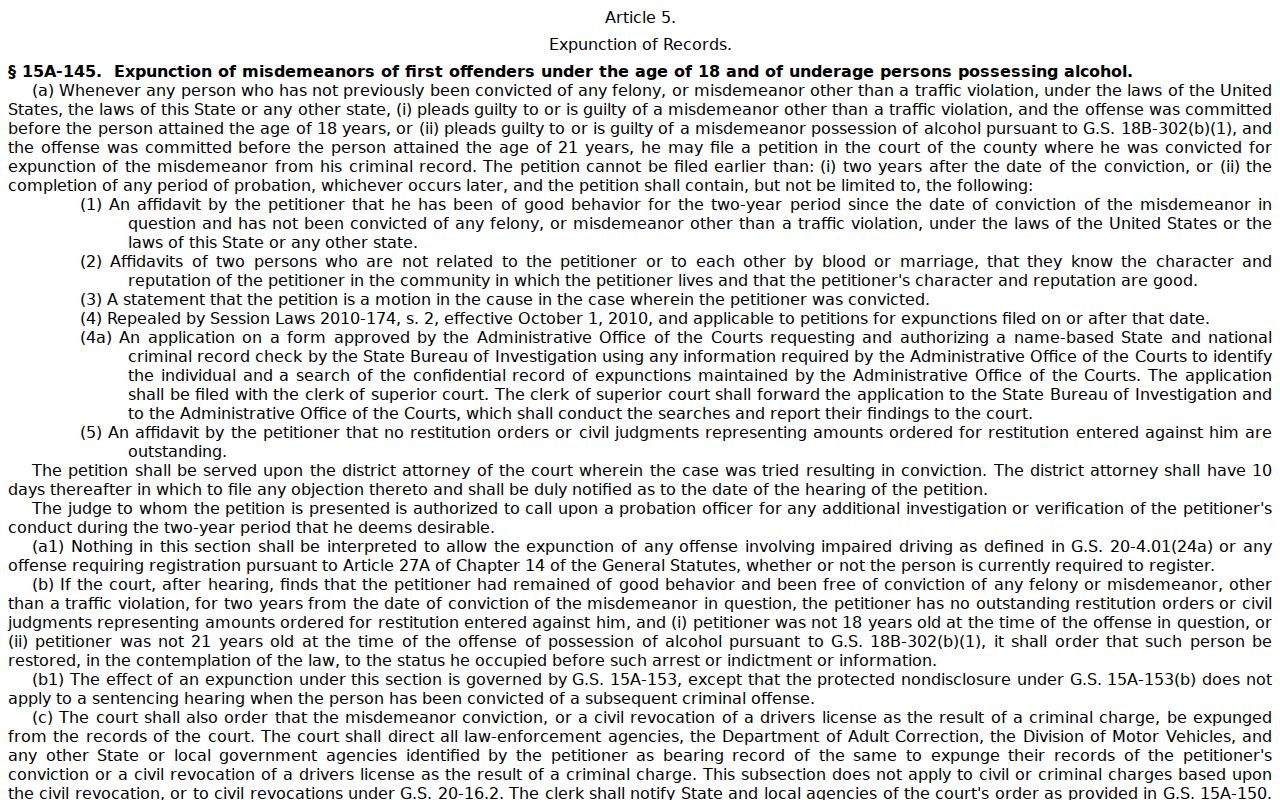
An expunction, a sealing problem, or a request for confidential material needs statutory or court-ordered authority. Confirm the specifics with the Wilson clerk first.
Wilson Criminal Docket File Fallback
Portal shows a public Case Summary, not the whole Wilson County criminal file. Need an order, judgment, filed paper, document image, or certified copy? Take the case number straight to the Clerk of Superior Court. The courthouse sits at 115 E. Nash St., Wilson, NC 27894. The main and criminal contact number is (252) 206-3000. At the counter you can use a terminal. You can inspect files and request copies there. The Judicial Branch's court-records guidance draws the line between the Case Summary and the clerk file. It keeps transcripts separate from docket review. One more distinction matters here. The NCAOC public-record form covers agency administrative records, not Wilson pleadings or case information. Call before mailing any money for a copy, certificate, or other formal record. The statewide chart lists copying and certification charges separately. It gives no all-purpose Wilson certified-docket price. The clerk can name the record. The clerk can confirm the payment method, quote the current fee, and explain delivery options.